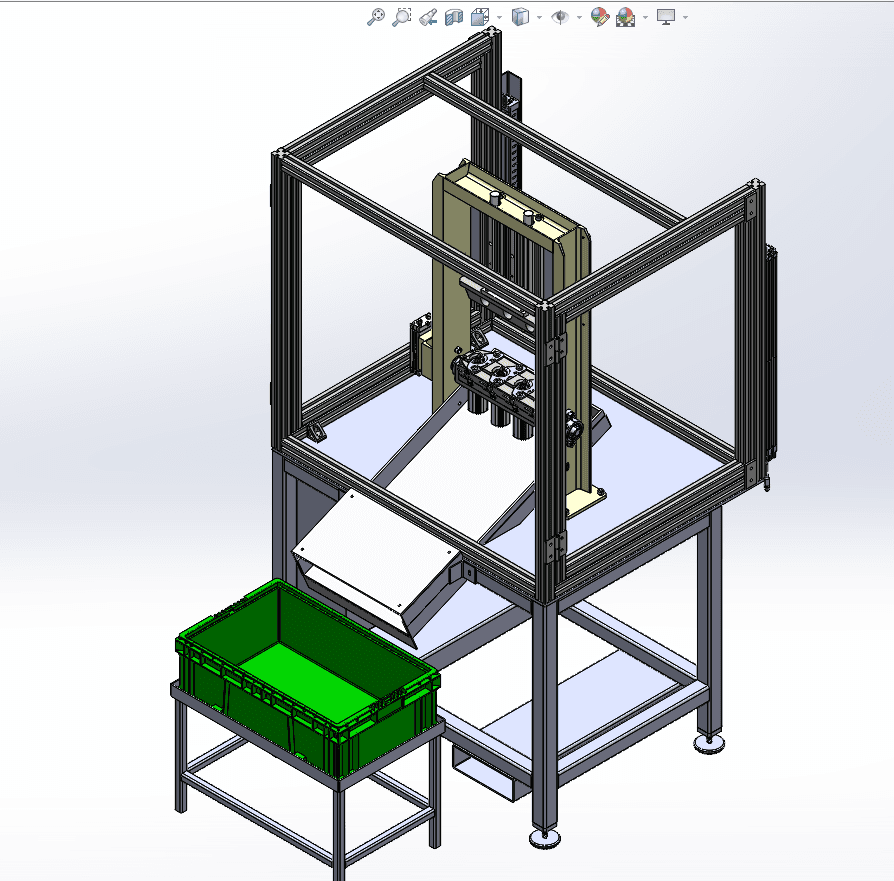
Semi-Automated Door Hinge Press-Fit Cell
Toyota Door Hinge Line
·SolidWorksGD&TDFMPneumaticsFixture DesignEngineering DrawingsRoot Cause AnalysisDesigned tooling and fixtures for a 70k units/year semi-automated door hinge press-fit cell, increasing output from one to five parts per cycle while integrating a second operation through tool changeover.
Overview
This project focused on a single station within a larger, standardized Toyota door hinge cell, where operators manually press-fit a rubber cap into a stamped hinge component using an arbor press. The repetitive manual force required led to operator fatigue and a measurable increase in cycle time as the shift progressed. The goal was to redesign the station to reduce operator strain while increasing throughput.
Problem & Solution
The core issue was ergonomic: repeated manual force compounded fatigue over a shift, slowing the process down over time. Working within the company's standardized outer cell architecture, I designed a semi-automated internal system to replace the manual press-fit. I also identified a second, similar press-fit operation running manually elsewhere in the plant, and designed a tool changeover so the new station could perform both without a dedicated second cell — after first calculating the station's maximum yearly throughput to confirm it could absorb the added volume.
Approach
I designed all internal tooling and fixturing within the cell — fixtures, press tooling, actuator selection, sensor placement, and the changeover mechanism — while the outer cell frame followed standard company protocol. In the semi-automated sequence, the operator loads the hinge component and rubber cap; the station verifies part placement and confirms the safety sensor net is clear; the actuator performs the press-fit; and the fixture rotates to deposit the finished part into a collection bin before resetting. This raised output from 1 part per cycle to 5. I started with CAD models of the fixtures, built the tooling around them, specified off-the-shelf components, and produced engineering drawings, including material selection for manufactured parts. I worked closely with tooling engineers to confirm manufacturability and with floor technicians to plan the changeover procedure and sensor wire routing. All CAD for the tooling and fixtures was my own design; the outer assembly cell itself followed standard architecture. My co-op ended just before manufacturing began, so I wasn't present for installation.
Results
- —Increased production capacity from 1 part per cycle to 5 parts per cycle
- —Integrated a second press-fit operation through a tool changeover, eliminating the need for a separate station
- —Reduced required operator count by 50% while improving overall process efficiency
- —Improved part cycle time by approximately 2.5×
Gallery