Formulus
Formula One Aerodynamic Design
·SolidWorksCFDAirShaperSurface ModelingThermal AnalysisAn aerodynamically optimized F1 car that simulates 10,300 N of downforce — 32% more than current grid cars.
Overview
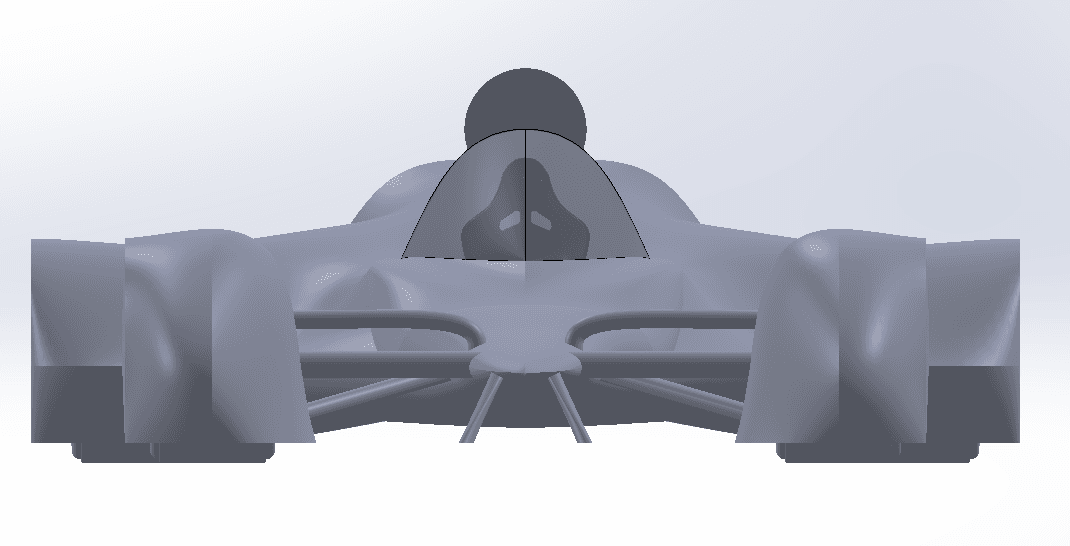
Formulus is a solo project where I set out to design a Formula One car optimized purely for aerodynamic performance — maximizing downforce while minimizing drag, with the entire body treated as one continuous, inverted airfoil.
Problem & Solution
Airfoil CFD simulations initially returned unrealistic pressure distributions — resolved by switching to a more appropriate solver and correcting boundary conditions. Full-model simulations exceeded available computing power, so the workflow migrated to AirShaper (cloud CFD). Ran iterative CFD loops to tune wing profiles and underfloor geometry, maximizing the pressure differential between top and bottom surfaces.
Approach
I began with concept sketches, iterating through several full-car layouts before settling on a direction. The most impactful early decision was to fully enclose the wheels in bodywork rather than leaving them exposed as on a conventional open-wheel F1 car — research showed exposed wheels account for roughly 30% of a car's total drag from the turbulent wake they generate, making this a high-value target. I also investigated how overall car length affects the drag/downforce trade-off, weighing added skin-friction drag against improved underbody airflow management. With a rough sketch of the car's proportions set, I selected a NACA 4-digit series airfoil for the wing elements — a well-documented, predictable profile that made a reliable starting point for CFD tuning. I ran simulations in Fluent, iterating on camber and thickness to maximize the pressure differential between the upper and lower surfaces without triggering flow separation, repeating the loop until the profile met my targets. I then moved into SolidWorks to build wireframe geometry for the car's major assemblies — nose, sidepods, floor, and wings — before surface-modeling over the wireframes. Early passes sometimes produced invalid or non-smooth geometry; I resolved this by rebuilding problem surfaces from cleaner reference curves with tighter continuity constraints between patches, iterating until the surfaces met both the aerodynamic and geometric requirements.
Results
- —Achieved a simulated downforce of 10,300 N — exceeding current F1 cars by 32%
- —Established a proven baseline workflow for rapid aerofoil tuning
Gallery